
What Is a CI/CD Pipeline?
A CI/CD pipeline is the automation that moves your code from a commit to running software. It merges changes, runs tests, builds artifacts, and ships them to an environment without a human babysitting every step. Two practices sit underneath it.
Continuous Integration (CI) is the part that runs every time someone pushes. Developers merge into a shared branch several times a day, and each change kicks off the same checks: linting, unit tests, static analysis, a build. The point is to catch a broken merge in minutes, while the author still remembers what they changed, instead of three weeks later when nobody does.
Continuous Delivery (CD) takes whatever CI blessed and gets it ready to ship to staging or production. Every change stays in a deployable state. You can release on demand without a long manual checklist.
Continuous Deployment goes one step further and removes the human from the release entirely. Validated changes go straight to production. Done right, you get faster feature rollouts, quicker fixes, and smaller, less scary deploys.
Put together, CI and CD cut down the manual mistakes and the lead time between “code is written” and “users have it.” That is the whole game.
We treat a pipeline as something that changes as the codebase grows, not a one-time setup you build and forget. Through our DevOps Consulting Services, we help teams design and scale pipelines that stay fast and reliable as the system gets bigger.
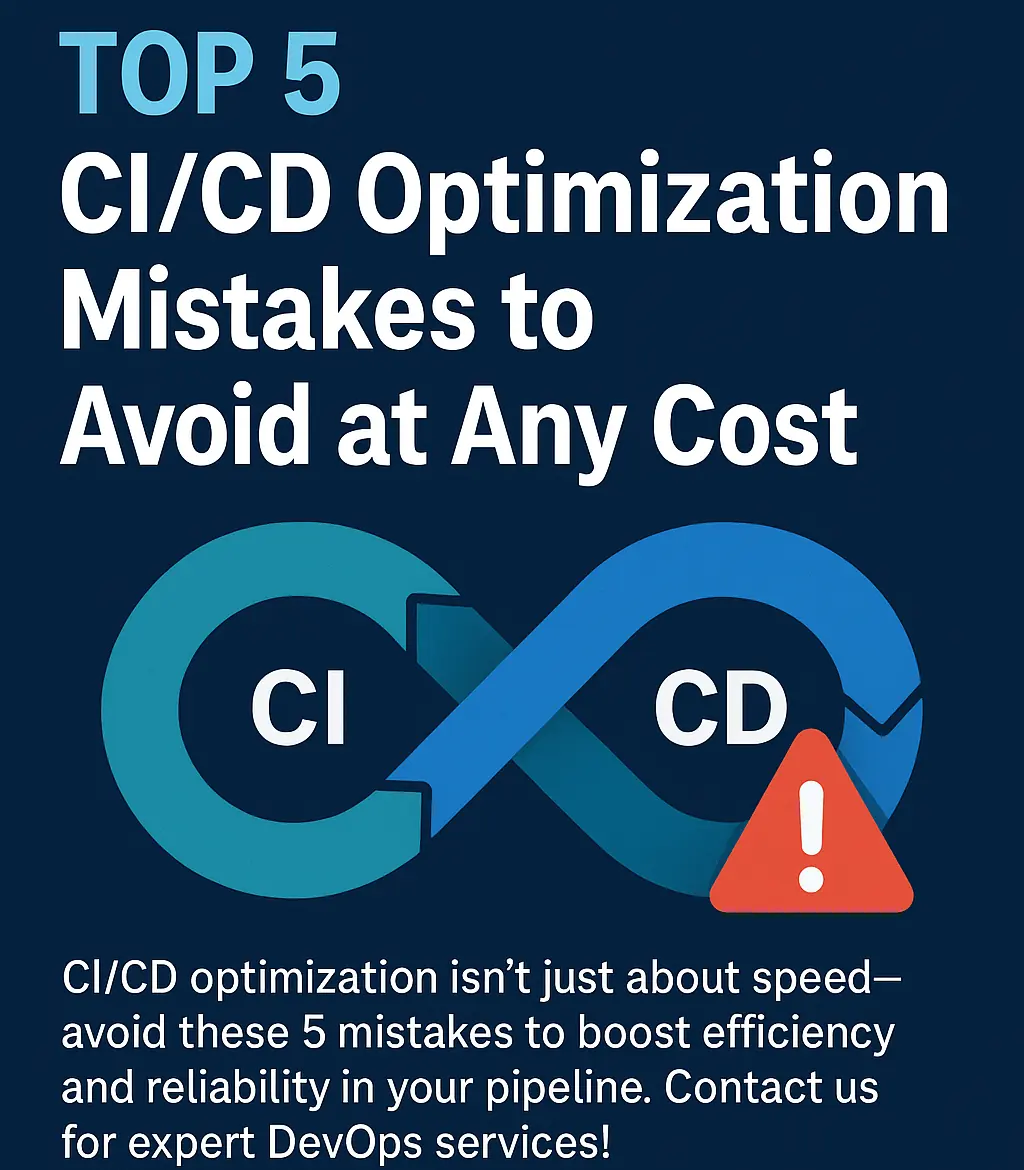
5 Mistakes to Avoid for CI/CD Optimization
These are the five that show up most often when we get called in to figure out why deploys are slow, flaky, or scary.
1) Treating CI and CD as the Same Thing
CI and CD are not the same job, and conflating them is where a lot of pipelines go wrong. CI integrates code and tells you whether it works. CD takes working code and gets it to production safely. They have different failure modes and different quality gates.
When teams smush them together, one of two things happens. Either everything auto-ships with no real gate between “tests passed” and “this is live,” or the deploy step gets so bolted onto the test step that nobody trusts it and every release becomes a manual ordeal.
Keep them as distinct stages with their own gates. CI proves the change is sound. CD decides when and how it reaches users. That separation is what lets you tighten one without breaking the other.
2) Ignoring Environmental Parity
It works on my machine. It works in staging. It falls over in production. That gap is environment drift: the small differences in OS version, installed libraries, dependency versions, or API endpoints that pile up between dev, staging, and prod until behavior stops being predictable.
The fix is to stop hand-configuring environments. Define them as code. Containers (Docker) plus infrastructure as code (Terraform) mean every stage is provisioned from the same definition, so the thing you tested is the thing you ship. No surprise package on the prod box that nobody documented.
Infrastructure parity is only half of it. The database is where parity quietly dies. Schema changes, new tables, and updated stored procedures need to land in every environment in the same order, every time. Put database migrations in the pipeline so they are version-controlled and deploy alongside the application code that depends on them. That kills the 2 a.m. “someone ran the migration on staging but not prod” page and the runtime errors that come from a schema mismatch.
Parity across infrastructure and data is not a nice-to-have. It is what makes a release boring, and boring releases are the goal.
3) Overlooking Pipeline Security
The pipeline has credentials to your infrastructure and ships code to production. That makes it a target, and far too many teams treat it as an afterthought.
Build the security checks into the pipeline itself rather than bolting them on later. This is the DevSecOps idea, and in practice it means a few concrete things: scan your dependencies for known vulnerabilities on every build, keep secrets out of the repo and out of build logs, and apply least-privilege access controls to the pipeline’s own roles.
On AWS, that usually means pulling secrets at runtime from AWS Secrets Manager or AWS Systems Manager Parameter Store instead of baking them into images or environment files, and scoping IAM roles down to exactly what each stage needs. A leaked deploy key or an overly broad IAM role is one of the fastest ways to turn a routine deploy into an incident.
4) Not Monitoring Pipeline Health
Plenty of teams build a pipeline and then never look at it again until it breaks. Without metrics, you have no idea your builds have crept from four minutes to fourteen, that a flaky test is failing one run in five, or that someone quietly disabled a test suite to make the red go away.
Track the numbers that tell you the pipeline is healthy: build duration, pass/fail rate, and test coverage over time. Watch the trend, not just the latest run.
Send those metrics somewhere you will actually see them. Amazon CloudWatch, Prometheus, and Grafana all work, as do the dashboards built into most CI tools. Set alerts so a degrading build time finds you before a developer complains. The whole reason to measure is to catch the slow rot early and keep the delivery system fast and reliable.
5) Relying on Manual Approvals for Every Stage
A manual approval gate has its place. Putting one in front of every stage does not. Do that and the pipeline crawls, developers context-switch waiting for a click, and the approval becomes a rubber stamp nobody actually reads.
Excessive manual gates are almost always a symptom of not trusting the automation. The honest fix is to make the automation worth trusting. Better test coverage, canary deployments that expose a change to a slice of traffic first, and a rollback you have actually tested all buy you the confidence to drop the gate.
Cut the approvals that exist out of fear rather than real risk, and you get continuous deployment that holds up. Keep the one or two gates that protect something genuinely irreversible.
Wrapping it Up
A pipeline that is fast and trustworthy pays for itself every single day your team ships. Avoid these five and you get releases that are quicker, safer, and far less likely to wake someone up at night.
If you are standing up a pipeline for the first time or trying to fix one that has gotten slow and fragile, that is the work we do. Take a look at our DevOps Consulting Services, or get in touch and we will dig into your setup with you.