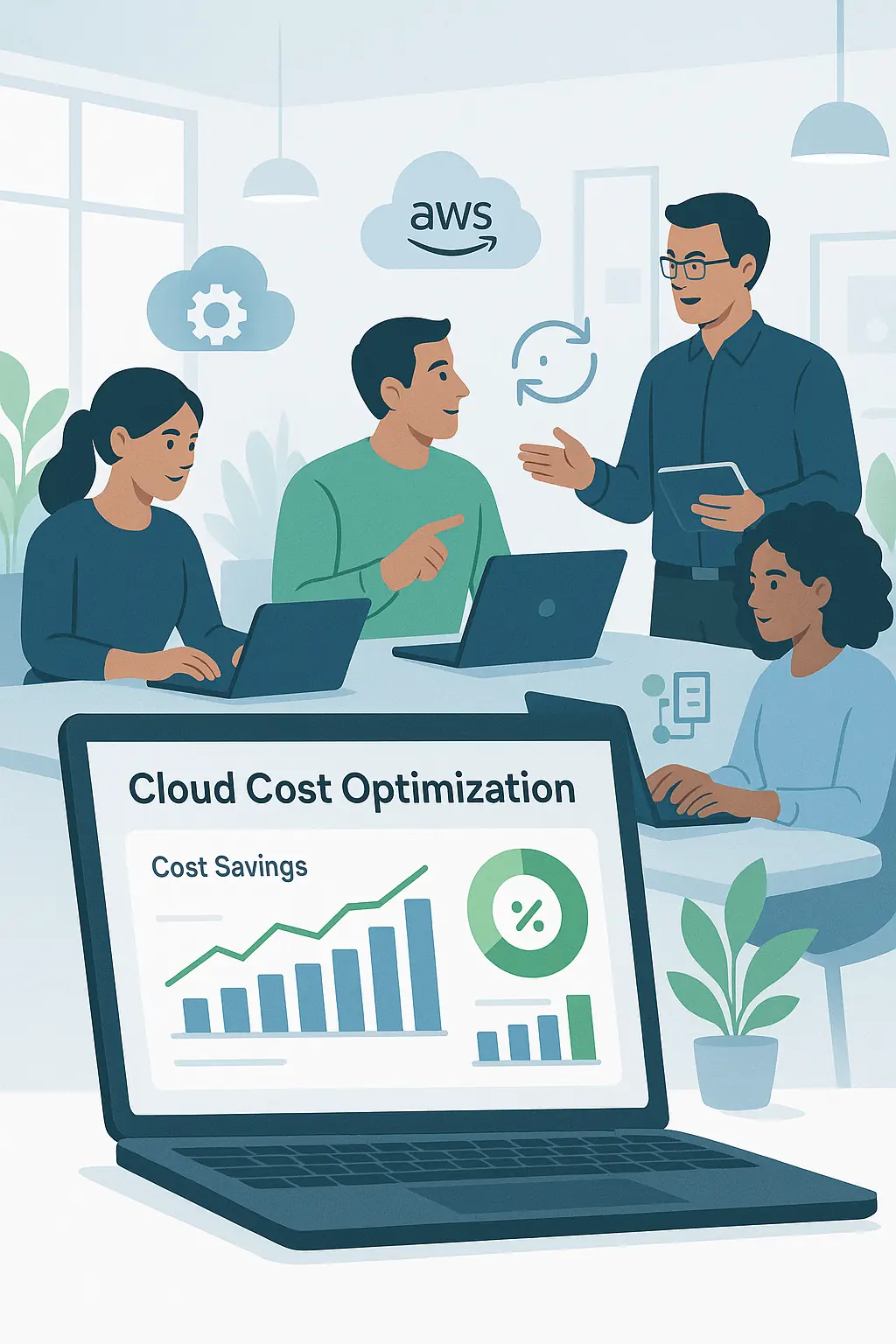
AWS makes it trivially easy to spend money. You can stand up a fleet of instances in an afternoon, and most teams do. The bill shows up at the end of the month, nobody can fully explain it, and finance starts asking pointed questions. That gap between “we can launch anything” and “we know what any of it costs” is where cloud waste lives.
This guide covers why cost optimization is worth your attention, where the money usually leaks, the levers that actually move the bill, and how to know whether any of it worked. It also covers how we approach the work at Forged Concepts.
Why Cloud Cost Optimization Matters
AWS, Azure, and Google Cloud are built for speed and scale. The same features that let you ship fast also let you overspend without noticing. Industry studies put wasted cloud spend at 30 to 50 percent: idle instances, misconfigured services, resources somebody forgot to delete six months ago.
An unpredictable cloud bill is not just a finance headache. It pulls engineers off roadmap work into emergency cost reviews, it makes capacity planning a guessing game, and it tends to spike at exactly the wrong moment. Getting costs under control is about building something you can actually plan around, not just shaving a few dollars off the total.
Done well, it gets you:
- Lower monthly AWS bills with no hit to performance
- Budgets you can forecast instead of explain after the fact
- Less risk and downtime from infrastructure nobody understands
- Faster delivery, because engineers stop firefighting and start shipping
Common Causes of Cloud Overspending
The same handful of problems show up in almost every environment we touch.
Over-provisioning is the big one. Instances sized for a peak that never comes, running at 10 percent CPU around the clock. Then there are the orphans: unattached EBS volumes, stale snapshots, Elastic IPs that detached from a terminated instance and quietly keep billing. None of it does anything except cost money.
Lifecycle gaps are next. Dev and staging environments run nights and weekends because nobody wired up a shutdown schedule. Add the costs that do not show up in the obvious places, NAT Gateway data processing charges and cross-AZ data transfer being the usual suspects, and the number climbs fast.
The one that makes everything else worse is poor visibility. No tagging, no Cost and Usage Report worth reading, no way to say which team or service owns which line item. You cannot fix what you cannot attribute.
Every one of these is preventable. It takes a strategy, some automation, and a real view into where the money goes.
How to Approach Cloud Cost Optimization
Whether you run this in-house or bring in help, these are the moves that pay off.
1. Assess and Benchmark
Find the waste before you touch anything. Pull the Cost and Usage Report, look at utilization, and figure out what “normal” should look like for your workloads.
Tip: AWS Cost Explorer gets you started fast, and a proper CUR analysis goes deeper.
2. Tag and Track Resources
Set a tagging policy and enforce it. When every resource carries an owner, environment, and cost center, you can finally say where the money goes instead of guessing.
3. Automate Scaling
Match capacity to demand with auto-scaling and scheduled shutdowns. Provisioning for peak and leaving it there is the most expensive habit in cloud, and it is also one of the easiest to fix.
4. Review Pricing Models
On-demand pricing is the most expensive way to run steady workloads. Savings Plans and Reserved Instances cover your baseline, Spot handles the interruptible work, and Graviton instances cut the per-hour rate for anything that runs on ARM. None of it costs you performance.
5. Monitor Continuously
Optimization is not a project you finish. It is a habit. Watch the dashboards, review spend on a cadence, and catch the next over-provisioned fleet before it becomes a line item you have to explain.
When this is baked into how the team operates, the bill stays boring and performance tends to get better on its own.
Advanced Best Practices and Tools
Once the basics are handled, a few things take you further.
Architect for efficiency. Break apart workloads that do not need to run as one always-on monolith. Serverless and right-sized microservices mean you pay for what runs, not for capacity sitting idle.
Rightsizing. AWS Compute Optimizer and Cost Explorer will flag over-provisioned EC2 and RDS instances and recommend better types. Two storage swaps are nearly free wins: migrate GP2 volumes to GP3 for the same performance at a lower rate, and turn on S3 Intelligent-Tiering so cold objects move down automatically.
Cost allocation. Build reporting that breaks spend down by team, project, or customer, so the people making decisions can see what those decisions cost.
KPIs. Track cost per customer, cost per API call, utilization rates. Pick metrics that tell you whether the work is actually paying off.
Governance. Decide who can launch resources, how they get tagged, and when they shut down. Write it down and enforce it through automation, not Slack reminders.
These do more than save money. Less sprawl means a smaller attack surface and fewer things that can break at 3 a.m.
How Forged Concepts Puts These Ideas Into Practice
If you do not have the time or the staff to do this internally, this is where we come in. Here is how the work breaks down.
AWS DevOps and Automation
Automation takes the human error out of provisioning and teardown, so waste never gets created in the first place. It also smooths out deployments, which means your team ships more often and rolls back less.
Learn more about our AWS DevOps Services.
Cloud Modernization
Old infrastructure is expensive to run and harder to secure. We migrate and modernize applications so they are easier to manage and cheaper to operate, and lower cost falls out of that naturally.
Learn more about our AWS Cloud Modernization services.
Cloud-Native Application Development
Designing for the cloud from day one means you skip the just-in-case over-provisioning that haunts lift-and-shift migrations. We build applications that stay fast and stable under traffic you cannot predict, without paying for headroom you never use.
Learn more about our Cloud Application Development services.
Managed AWS Cloud Services
We monitor, secure, and tune your environment so it runs lean every day. No month-end surprises, and your engineers stay on the work that actually matters.
Learn more about our AWS Managed Services.
Real-World Impact
A mid-size SaaS provider cut AWS spend by 10 to 15 percent within three months of working with us. We found the over-provisioned instances, automated the non-production shutdowns, and rolled out cost tagging so they could finally see where the money went. The savings showed up immediately and held.
Another client moved a legacy monolith to a containerized, auto-scaling setup. That trimmed infrastructure cost and, just as importantly, took their release cadence from monthly to weekly.
Frequently Asked Questions
What is cloud cost optimization?
Cutting waste and controlling spend across your cloud environment without giving up performance or reliability.
Why does it matter so much on AWS?
AWS gives you near-infinite flexibility, and that same flexibility makes it easy to overspend. Optimization keeps you paying for what you actually need while staying secure and able to scale.
How long until we see savings?
Most organizations see measurable savings inside the first few months, sooner when automation is part of the plan.
Will optimization slow down our apps?
No. A right-sized environment is usually faster and more stable than the over-provisioned mess it replaced.
Taking the Next Step
Cloud cost optimization is not a one-time cleanup. It is an operating habit. Run it in-house or bring in help, but either way the point is to make cost efficiency part of how you work every day, not a fire drill you run when the bill spikes.
If you want a hand putting this into practice, we bring the tools, the process, and the AWS experience to make it stick. Book a free consultation.