
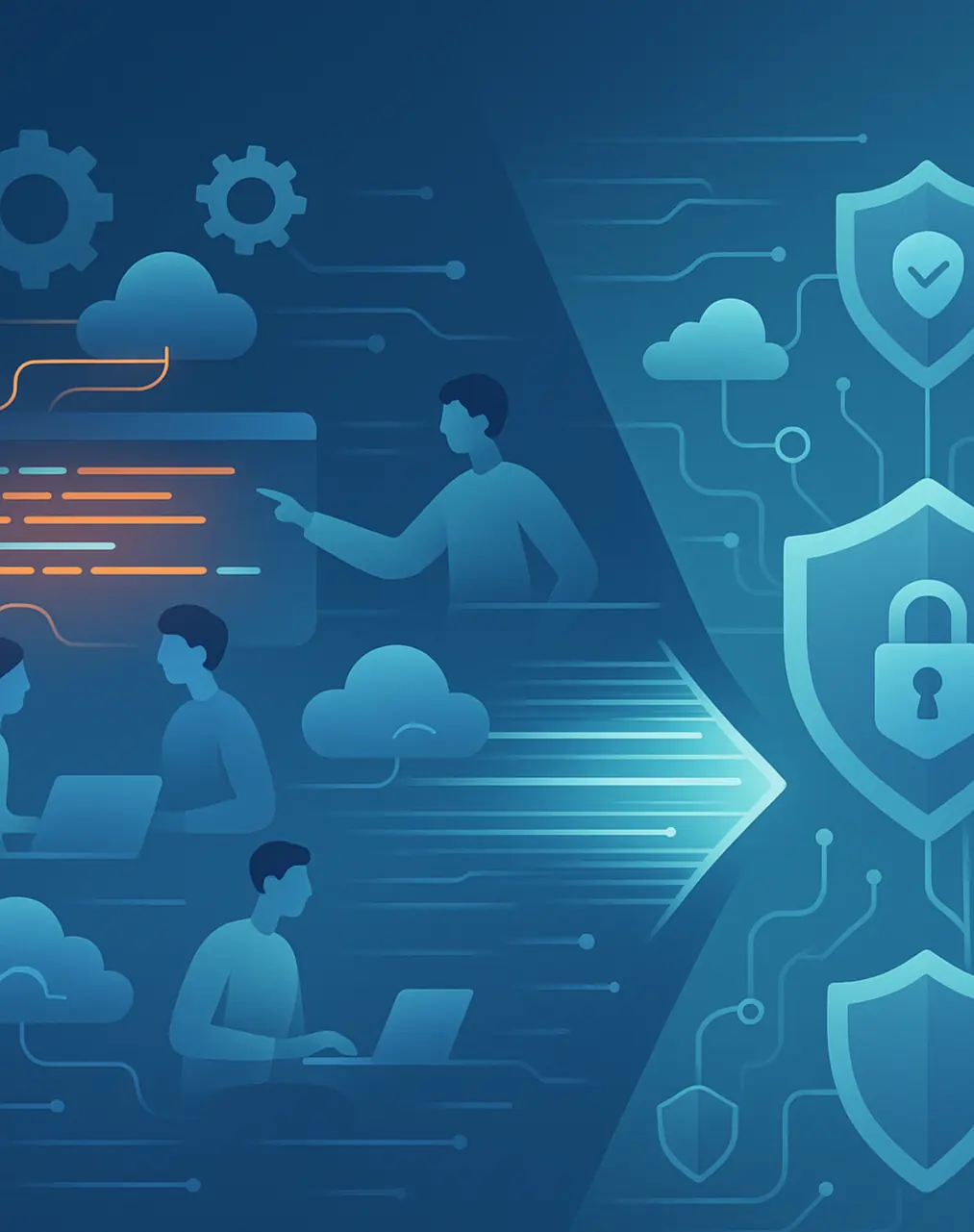
The Velocity Paradox and the Rise of Security-First Development
DevOps made teams fast. It tore down the wall between developers and operations, automated the release path, and let companies ship continuously instead of quarterly. That part worked.
Then the speed created its own problem: the security gate. When the security review is the last thing standing between a branch and production, it gets rushed, deferred, or quietly skipped. The vulnerabilities ship anyway.
DevSecOps fixes that by moving security into every phase of the pipeline instead of bolting it on at the end. Security stops being a checkpoint someone has to clear and becomes everyone’s job from the first commit.
We are senior AWS engineers, and we help teams build security into the pipeline without grinding delivery to a halt.
Reviewing the Foundation: What Is Traditional DevOps?
Start with what DevOps actually solved, because DevSecOps inherits all of it.
DevOps (Development plus Operations) is a culture and a set of practices that put developers and operations on the same team with the same goals. The point is to kill handoffs and friction across the whole software lifecycle.
Core Goals of DevOps
- Speed and automation: CI/CD pipelines that automate builds, testing, and deployment so releases stop being events.
- Collaboration: shared tooling, shared accountability, one set of goals instead of two teams pointing at each other.
- Continuous improvement: short feedback loops that let teams iterate fast.
Here is the gap. DevOps optimized for velocity and left security on the outside. Security reviews ran on a separate track, usually a few days before the deploy, which turns every release into a last-minute scramble. In high-velocity teams, that is one of the most common and most expensive failure points.
The Security Bottleneck: Where Traditional DevOps Fails
Traditional DevOps fails at security because of timing, not effort. In the security-gate model, the pen tests and vulnerability scans run at the very end, after the code is already built and staged and ready to ship.
The Consequences
- Costly rework: finding a critical flaw the day before launch means ripping code apart and rebuilding under deadline pressure. That is the most expensive time to fix anything.
- Slowdowns and friction: the security team becomes the bottleneck instead of a collaborator, which kills the velocity DevOps was supposed to deliver.
- Risk exposure: a vulnerability found at the gate has already lived through testing and staging, so the window of exposure is wider than anyone wants to admit.
When security runs last, it undercuts the three things DevOps exists to protect: speed, trust, and reliability.
The Evolution: Why DevSecOps Is the Secure Standard
DevSecOps is DevOps done right. Threats move too fast for security to be the thing you get to after the feature is done.
DevSecOps (Development plus Security plus Operations) wires security tools, processes, and policies straight into the automated workflow. Validation happens at every stage, from planning through production, not in a single review at the end.
The principle is simple: you do not pick speed or security, you build for both. That takes a culture change. Security becomes a shared, continuous responsibility across developers, operations, and the security team, not a department you throw code over the wall to.
Key Pillars of DevSecOps
- Security as code: keep policies and configurations (firewall rules, IAM access policies, and the like) in version control so they are consistent, reviewable, and auditable.
- Automation: run SAST and SCA scans and compliance checks automatically so security enforcement does not depend on someone remembering to do it.
- Proactive mindset: move from find-and-fix to prevent-and-protect. The question shifts from “did we pass the scan” to “how do we make this secure by default.”
The payoff is a pipeline that stays compliant and ships secure code without slowing down.
The Crucial Difference: Embracing Shift-Left Security
The real difference between DevOps and DevSecOps is shift-left security: pushing security work earlier (to the left) in the timeline instead of saving it for the end.
How It Works
- Plan and design: threat model and write down security requirements before anyone opens an editor.
- Code: run SAST (static analysis) in the pipeline so issues surface as the code is written, not weeks later.
- Build: run SCA (software composition analysis) automatically to flag known vulnerabilities in open-source dependencies.
- Test: fold DAST (dynamic analysis) and vulnerability scanning into continuous testing instead of a separate phase.
Fix a problem when the code is fresh and the fix is cheap, fast, and unlikely to derail a release. Catching issues early can cut remediation costs by up to 90% while keeping delivery velocity intact.
DevSecOps in Practice: The Essential Toolchain and Technology
DevSecOps is not just a philosophy. It runs on automation and a specific set of tools that hold a secure cloud environment together.
Infrastructure as Code Security
Security starts in the repos, where your infrastructure now lives. Terraform, Pulumi, and Ansible define your cloud as code, which gets you consistency and repeatability. DevSecOps makes sure that code is secure before it runs:
- Misconfiguration scanning: catch public S3 buckets, unencrypted data, and over-broad IAM permissions before they reach an account.
- Policy as code: tools like Open Policy Agent (OPA) block non-compliant changes automatically, so the guardrails run in the pipeline instead of in someone’s head.
Secrets Management and Access Control
Hardcoding a password or API key in a repo is how breaches start. DevSecOps keeps secrets out of code with tools like HashiCorp Vault or AWS Secrets Manager.
- Centralized vaulting: store credentials securely, outside the repository, with access you can control and revoke.
- Just-in-time access: hand out secrets only when they are needed, which shrinks the blast radius if something leaks.
- Rotation and auditing: rotate keys automatically and log every access for compliance.
Continuous Monitoring and Observability
Security does not stop at deploy. It keeps going in production, where the real traffic and the real attackers are.
- Beyond monitoring: monitoring tells you whether a system is up. Observability tells you why it is behaving the way it is, which is what you need at 3 a.m. during an incident.
- Intelligent incident response: SIEM and AIOps tools analyze logs and metrics in real time to spot anomalies, isolate threats, and kick off automated responses. On AWS, GuardDuty and Security Hub feed that loop. Done well, this cuts Mean Time to Respond (MTTR) and limits the damage from a live threat.
Conclusion: Building for Secure Velocity
DevOps changed how software gets built. DevSecOps is what makes that pace sustainable. If you run in the cloud, the job is to hold speed and security together instead of trading one for the other. That is what a secure DevOps pipeline actually is.
Run security last and your fast pipeline is also a fragile one. Shift it left, automate the guardrails, and back it with IaC and real observability, and you get delivery that is fast, compliant, and secure from the first commit.
Is your pipeline fast but fragile? Contact us for an assessment and we will show you how to shift left for secure, scalable velocity.